How Do You Colors For Cubefield
Without HDTV octopus can not believe their eyes. The octopus has a taste of luxury: HDTV or nothing! 
Australian researchers have discovered that with a montage of images exploiting the latest TV and a computer which provides 50 full frames per second - about 25 more - they were able to react octopus (Octopus
Tetricus  ) to videos of crabs (they rushed on their prey very popular) or congeners (they fled and hid). This opens very extended study their behavior with rigor.
 [
[ img]
Source: Robert Harcourt Their initial results show that octopuses have moods: some days they respond systematically, others not at all, or less. The author speaks of episodic personalities. This is an opportunity to discuss similarities and differences in the eye of the octopus and if it can be considered more advanced than ours. A high frame rate to react octopus A researcher at Macquarie University in Australia, Renata Pronk, studies the behavior of octopus (Octopus
Tetricus ), and tried to move from classic videos VHS (I presume) on screens TV next to the aquarium's cephalopods studied. Even from movies popular prey like crabs they did not react. With the advent of HDTV has tried to present their videos and they responded! She then explored how to videos produced specifically for display 50 full frames per second and transmitted from a Mac Mini on a monitor makes them react.
Fig 2: stimuli are presented on the screen left (Monitor), the behavior of the octopus is registered against Angle.
[
img]
Source: Pronk, R. She observed that they were rushing towards the screen when a crab was viewed. She offers videos of the Supplementary Material DEVICE OF Cf Movie 1 - octopus rushes to film crab.
Movie 2 - reacts octopus has a congener fleeing behind a kind of amphora.
Fig 3: The Octopus Crab attack video on the screen left (insert lower left) Click for video

[img
] Source: Pronk, R. The octopus has its moods! With this technique Pronk and his team conducted experiments on the behavior, to see if octopuses have personalities to find out whether The Animals Could Be Said To Have has personality. It defines personality as behavioral differences between individuals who persist over time and differences in contexts geologically important. " Personality Can Be Defined as Behavioural Difference between Individuals That Are consist over time and across
Ecologically important contexts," His team has submitted three days from 10 now threatening stimuli (conspecific) appetizing ( crab) or new (a jar) and a witness with a video without moving object. They found the octopus had moods: some day a given animal reacted strongly to the presentation of a given stimulus, but a few days later he was ignorant, or vice versa. Pronk speaks of "episodic personality "
I think - reading between the lines - that the researchers wanted to study the behavior and have encountered difficulties: the animals reacted differently every day. However, the repeatability is a condition normally required for results to be usable. Maybe they had the idea to transform the problem into a solution and publish on the mood of the octopus ... It would be smart, not ?
In any case she wants to explore other behaviors, "Pronk IS
keen to find out more about octopus Other behaviors, Including Their communication, learning and social interactions, using Her convincing octopus-movie system." said Knight (2010) Our visual environment depends on our sensory apparatus.
I think this is a good example to show that the perceived environment is dependent on the sensory apparatus of the animal, and I thought their eyes would have a shorter persistence of vision and that TV and movies Classic 25 or 30 frames per second does not create the illusion home movement. In fact
"It was long believed that the phenomenon of retinal persistence
allowed to explain why it feels
succession of still images from a movie like
scenes in motion."
Dubuc, Bruno (2008).
. The discussion of the illusion of movement and the reasons why the persistence of vision can not be the case here in the excellent The brain at all levels. Mc Gill " The illusion of movement in film would be produced by another phenomenon
effect called beta
. It
be due to stimulation of some retinal neurons specialized in detecting movements
. This occurs when two slightly offset images are shown rapidly one after the another. Our brain automatically sees a movement, a result of the integration work
receptive fields of retinal cells and different cortical areas involved in visual detection and direction of movement. "
Dubuc, Bruno. (2008).
Presumably the eoil cephalopods detect movements faster, but this article does not say. The eye of the octopus would be more demanding, more sensitive to the rate of succession of images?
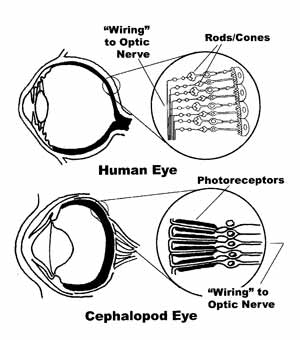
should perhaps leave this question open for now! Beautiful research to do for our students who become scientists! The eye of the octopus "more evolved"? By cons can be considered as the eye of the octopus is better structured as "wired in place." Indeed, our eye has a structure that would respond engineers : Neurons are before the photosensitive rods and cones, and they have their part are sensitive to light are planted in the retina, as they turned their backs on the light. In fact our eye is a well good enough to allow us a remarkable vision, but it was difficult to see the perfection ... a craft rather extensively improved by natural selection ...
Fig 4 The human eye seems wired "backwards" with the light that must pass through several layers before reaching the neuron cells photo-receptor (cones and rods). [img
] Source
Fig 5 The octopus retina is inverted relative to ours and seems wired "in place" with the light that comes directly to cells photo-receptor (cones and rods). [img ] Source
Halder, G., P. Callaerts, and WJ Gehring. New Perspectives on Eye Evolution . Current Opinion in Genetics & Development
. 1995; 5:602-60. amended
here
 The question of homology in the evolution of the eye is treated in depth in recent 3 articles in Nature or Science: Fig 6: Deep homology of eye development and evolution The Parallel of animal eyes. [img
 ] Source: Shubin, N., Tabin, C., & Carroll, S. (2009).
Fig 7 : Eight major types of optics in animal eyes:  [Img
[Img ] source :Fernald, R. D. (2006).
Fernald, R. D. (2006). Casting a Genetic Light on the Evolution of Eyes.
Science , 313 (5795), 1914 -1918. doi:
10.1126/science.1127889
Shubin, N., Tabin, C., & Carroll, S. (2009).
Dubuc, Bruno. (2008),
The brain at all levels. Mc Gill
Knight, K. (2010).
OCTOPUS REACT CORRECTLY TO HDTV
. J Exp Biol
,
213
(7), i-a-.
Fernald, R. D. (2006). Casting a Genetic Light on the Evolution of Eyes. - Science , 313 (5795), 1914 -1918. doi: 10.1126/science.1127889
- extraits intranet.pdf Lamb, T. D., Collin, S. P., & Pugh, E. N. (2007). Evolution of the vertebrate eye: opsins, photoreceptors, retina and eye cup. Nat Rev Neurosci, 8(12), 960-976. extraits intranet.pdf
Pronk, R., Wilson, D. R. and Harcourt, R. (2010). - Video playback demonstrates episodic personality in the gloomy octopus . J. Exp. Biol. 213, 1035-1041.. [Abstract/ Free Full Text]
The nadked Scientist (2010) - Octopus mood swings revealed in high definition
Listen to News Item -
[as MP3] - Shubin, N., Tabin, C., & Carroll, S. (2009). Deep homology and the origins of evolutionary novelty . Nature, 457(7231), 818-823. experimental blog about the evolution of biology. To explore how we could keep alive the link between research and teaching.
 Australian researchers have discovered that with a montage of images exploiting the latest TV and a computer which provides 50 full frames per second - about 25 more - they were able to react octopus (Octopus Tetricus
  ) to videos of crabs (they rushed on their prey very popular) or congeners (they fled and hid). This opens very extended study their behavior with rigor.
  Fig 1: An octopus in a crevice.




0 comments:
Post a Comment