 Man differs from the "monkey" of 1.3%, while each human differs by 12%!? Many figures on the difference between humans and chimps appear to move but contradictory. Calculated by different methods, they have meaning only knowledge of how they are established. Was used in the past immunological similarity, hybridization of DNA molecules, most recently the identity of particular sequences (SNP) and the comparison base to base sequences or whole genomes. And the list is certainly not complete. Obviously these methods give different results each time. There are sometimes an entire gene as different from one base is different, while other methods compare one by one 3 billion bases of our genome with 3 billion of the chimpanzee. Some account for a shift of a sequence as many differences, others do not detect this type of change. Give a single digit is unscientific and misleading. It is unsettling to students compare to other figures in the press, TV and internet. This is likely to discredit the teacher if a figure just as absolute and true. It is also be open to criticism from those who want to believe a single truth and simple: they are happy to show different figures as inconsistencies. Why so much interest for this difference? man has long wondered about the disturbing similarities with the "monkey" (I question whether a term that includes very different animals from the size of a cat to that of the gorilla ) including other primates, especially the hominids ( UniProt
  ) (tailless apes) and especially the chimpanzee (Pan troglodytes ). One can not help but see in his facial expressions, appearance, behavior social similarities touching. [ img] Source: Gould, J., et al (1994) File "ape" over hominidés.com
  Everyone has witnessed strong reactions of rejection and a need to mark the distance with that annoying cousin.
 would by reading the work of Darwin. (This quote
appears in different forms, I pulled this quote from Pascal Picqhere
)
At the turn of the conversation on these similarities and differences, often comes the proverb "Shoo natural change their spots" in reference to certain behaviors, socially unacceptable, who showed an origin in chimpanzees. Although this is not the correct meaning of the proverb is almost as if our fears that our emotions and take us beyond the control is crystallized on this being so close and yet different, as F. Terrasson (1997) describes in "The fear of nature." Why we so scared of being next of kin of a chimpanzee? That's what one of many Desmond and Ramona Morris studied in "Men and Apes." They discussed the monkeys sacred, representations of monkeys as mad or fishermen, as lovers and as intelligent animals. For (Geets 2003), behind the fear of difference lies in the fact that fear is not so different ... Leave this question for now to focus on these individual differences ... Old methods One of the first measurement methods that have dug up my research summary is immune. This much we placed a 15% difference of our cousin the chimpanzee. "The reaction to the precipitin shows that 85% of plasma proteins from chimpanzee are homologous to those of man. "Miram, W., & Scharf, KH (1998). biology from molecules to ecosystems. Lausanne: LEP Leisure and pedagogy. p. 433 [ img] Source : Vogel et al. (1970) Here we speak only of blood proteins and compared their affinity antibodies. Figure 2 suggests that peer wants to say here that the protein of the chimpanzee is agglutinated by antibodies against human proteins. So they have the same epitope. DNA-DNA hybridization
- Other methods have been used as the hybridization of genomes Whole described here intranet.jpg Source Miram, W., & Scharf, KH (1998).
Atlas of Biology (Vogel, G., et al., 1970) also cites this method p. 511 and asserts that the hybridization between humans and rhesus monkeys is 85%.
The first results by sequencing
Since sequencing is available and the cost down very quickly, new ways of measuring similarities and differences appear. For a long time we saw a figure close to 1.5% in many educational references.
example Miram-Scharf talks about 1.2% during that Watson, JD, et al (1994) Online said here P. 446 "The genomes of humans and chimpanzees differ in fact only 1.6%"
The way to measure is not described, but probably base substitutions in selected genes we had available at the time, by aligning short sequences. This measure does not take into account the differences resulting from the displacement of the inversion or duplication of sequences, because it seeks, in short - the alignment then the differences on these small aligned sequences.
Understanding alignment to find evidence of evolution is crucial for teachers said Profs. Brigitte and Denis Duboule Gaillot at a conference for teachers of biology in the spring of 2009.
( Scenario 5: Evolution of insulin but can be used with any other protein)
Genomics enables new comparisons
Since 2001 (International Human Genome Sequencing Consortium. 2001
here )
the human genome is fully available, and since 2005 that the chimpanzee / The Chimpanzee Sequencing and Analysis Consortium. 2005)
here We learn that differences in terms of base substitutions are 1% and rearrangements, duplications and travel is our genome sequences diverge by 2.7% more. It is also true of about 1% or 3.7% ... [
img] Source: For Science No. 57
Nature special chimpanzee
and provides a Web folder
focu "The chimpanzee genome They have clarified the problem nicely:" We share More Than 98% of Our DNA and Almost all of Our Closest Living With Our Genes on, The chimpanzee. "We share almost 98% of our DNA and almost all our genes with our closest relative today: the chimpanzee.There is a
interactive animation that compares our two species in several ways: if you click on the shoulder of the chimpanzee highest one finds indications of differences genetic. " It Is Often Said That The Two species are 98.5% the same, in terms of single-letter DNA code In The Exchange. Goal Of The chimpanzee genome mapping shows There Are Further differences in how DNA chunks are duplicated and rearranged. Thesis differences due to divergent sequences o genome by 2.7%, while single-letter substitutions Another add about 1% of difference. "
The NCBI maintains a portal chimpanzee
- The NCBI offers free access to the complete genomes for example from MapViewer which helps to realize that many genomes are available (as of human the living world, prior to a phylogenetic tree, etc.). Viewed "Karyotype" Chimpanzee Genome Viewed "karyotype" of human genome
- Total Chromosome:
- 2346) compared chromosome has chromosome is possible.
-
- Michel Morange gave a lecture 06.12.2008 "The man and monkey" video here
- (Channel U)
- Site creationist Harun Yahya which tries to discredit evolution by comparing the numbers of similarity of DNA prepared by methods différentes.On is clear that scientific knowledge can be in reference to data, but also the methods that produce them.
differences: not only are genes?
a comparison of the entire human genome and the chimpanzee (see Bio-Hills of May 5, 2007 "The chimpanzee - We see that the former focus on
genes, which ignored the rest of the DNA, misses important differences ... - The difference between two humans: 0.1% or 12%? Bill Clinton repeated in 2001 with the provision that the Human Genome " Humans are all, Disrespect of race, 99.9% Genetically The Same.
" - " surprising result: between two individuals. there are only 0.1% difference! Briefly, a needle in a haystack that continues to sharpen the curiosity of researchers ... "While in Science et Vie (2008) ( intranet.jpg) we read that" From an individual the other genes differ by 12%.
- hard to reconcile! Here is the number of genes that have at least one tiny difference: 3,000 genes differ by at least one base between two people nearly 12% of the approximately 21,000 genes ( that figure also change depending on how you measure, not bother me with that is an order of magnitude ) Thus 0.1 and 12% are equally true (currently ...) but measured differently.
- more evolved than us?
- ). They searched areas of our DNA that have more variety here than in chimpanzees (compared to another genome). They found very few differences in the genes, but in the non-coding DNA they have found Human Accelerated Regions (MDT), one of which seemed to have changed particularly quickly: called HAR1F, it is expressed between the 9th and 17th week of pregnancy-critical period where neurons form and migrate in a region brain (Cajal-Retzius), which determines the layered structure of the brain. It is tempting to imagine that this RNA would have a regulatory role, and activates many other genes, ensuring the further development of our brain and ... we would be reassured about the reality of differences with the "monkey"!
Check Hayden, Erika (2007)
here reports that these figures do not account for significant rearrangements: travel, inversions and other réarrangments, which seem to affect much of our genome (one author mentioned 10 % in 2007). An Inuit and I differ by 1% but I have only 50% in common with my own daughter? In the excellent site thenakedscientist found a nice problem situation to begin an investigation by the students: If
have a human I share 98% of my genes and chimpanzee With A 60% of my genes With A Banana, how I come only share 50% of my genes with My own daughter?
The most recent figures on human diversity ...
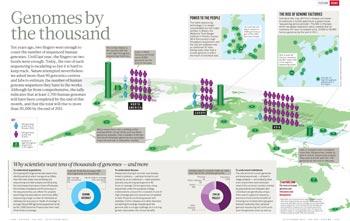
An ongoing project The 1000 Genomes Project Consortium. (2010) miles genomes sequenced wants to take the measure of the diversity of our species. They have already analyzed after "rapid sequencing (
low coverage ) 179 individuals from four distinct populations by sequencing and very thorough (
high coverage) two trios: mother-father-child; They still have sequenced 8140 genes exons covering 906 697 people.
Fig 5:
e project The 1000 Genomes Project will sequence to compare 1000 Gen
 omes whole .. [ img] Source: The 1000 Genomes Project
 . The 1000 Genomes Project offers tutorials and videos here
Comment: Human genome: Genomes By The Thousand , 1026-1027 (2010) in Nature The 1000 Genomes Project Consortium. (2010) and a News & Views of R. Nielsen here gives a summary of the very many numbers that may affect the education, here's a selection: On average each person has approximately 250 to 300 variants " loss-of-function (which produce a nonfunctional protein) and 50 to 100 variants known to be involved in hereditary diseases. We live pretty well this situation (healthy carriers), because we are heterozygous for these genes and these diseases are recessive (or there are redundant genes). Each individual would still be homozygous for 30 mutations linked to genetic diseases. From the two trios, they estimated the mutation rate in the germ line (eggs, sperm) for base substitutions ( rate of de novo germline mutations base substitution) at about 10 -8 per base pair per generation. That would still 30 mutations per generation for our genome of 3 billion (10 9 ) if I'm not mistaken ... (thank you to those who have pointed out the error!) Their results here indicate that an individual typically differs from the reference sequence ( here
) by:
- 10'000-11'000 non-synonymous sites: a base change in a codon resulting in an acid different amino 10'000 12'000-synonymous sites: a base change in a codon that does not change the corresponding amino acid.
- 190-210 insertions / deletions (in-frame indels ) premature stop codons 80-100 40-50 variants perturbernt which splice sites (splice-site- Disrupting )
220-250 deletions that shift the reading frame.
 So this project is a little better characterize this human diversity and distinguish more meanings in this uncultivated percent ...
 Conclusion The contrast of some of these figures could be good primers for the problem situation: they challenge students, raise questions, reveal some obstacles ... ( intranet.pdf
)
We also see a figure in science-has meaning only in relation a measurement method. It is therefore difficult, but important to learn to critically interpret information, even that of Nature or Science ...
"This is a
very delicate time, and a dangerous time, as people start to Come Up With Things That The General Public, The Media Gold, Gold Various groups Might misinterpret," Sabeti says. "I like the Fact That, so far, weekends find the Evidence for Natural Selection in Humans Is Only Skin Deep."
Check Hayden, Erika (2007)
And finally these examples illustrate that knowledge is scientific only if it clearly establishes how the data support the assertion. Sources Check Hayden, Erika, (2007), So similar, yet so different. Nature News 17 October 2007
Human Genome: Genomes By The Thousand
Pollard, K. S., Salama, S. R., Lambert, N., Lambot, M.-A., Coppens, S., Pedersen, J. S., et al. (2006). An RNA gene expressed during cortical development evolved rapidly in humans . Nature, 443(7108), 167-172.
Skipper,
- Magdalena
. (20190) Nature Podcast 28th October -
Terrasson, F. (1997). La peur de la nature: Sang de la terre. - doi :10.1038/nature05113 The 1000 Genomes Project Consortium. (2010). A map of human genome variation from population-scale sequencing. Nature, 467(7319), 1061-1073.
- The Chimpanzee Sequencing
- and Analysis Consortium. (2005). Initial chimpanzee genome sequence and Of The Comparison with the Human Genome . Nature, 437 (7055), 69-87.
intranet.jpg
Vogel, G., & Angemann, H. (1970) . Atlas of Biology (Mr. Ricard, Trans).. Paris: Stock
experimental blog about the evolution of biology. To explore how we could keep alive the link between research and teaching.


0 comments:
Post a Comment